
In short
Palms are pruned between November and February, once a year, removing only dead or dying fronds and flower and fruit stalks, and never green fronds above the horizontal (the 9-to-3 rule). Cutting the top off kills the palm. Stripping it weakens it and attracts the red palm weevil. On tall palms the work is at height and should be done by professionals on ropes or a platform.
A palm is not a tree
The first thing to understand is that a palm does not work like an olive or a pine. It has no branches, the trunk does not thicken with age and it cannot regrow from any point. It has a single growing point, the meristem, at the centre of the crown, from which every new frond emerges. If that point dies, the whole palm dies. There is no second chance.
That changes everything about pruning. On a tree, cutting one branch stimulates others. On a palm, every green frond you cut is a frond the plant paid to make and will not replace any faster because of it. A palm produces a fixed number of fronds a year, depending on species and conditions, and cutting green ones just leaves it with less capacity to feed itself.
When to prune palm trees in the Algarve
Between November and February. That is when the red palm weevil flies least and when the cuts, which release a scent that attracts the females, are least dangerous. It is also when palms grow slowest and the clean lasts longest.
We know many people want the palm tidy for summer, for the holiday home or for guests. It can be done, but with care: cut the minimum, seal the cuts with a product the same day and, ideally, pair it with a preventive weevil treatment. A palm clean in July without protection is one of the commonest causes of infestation we see.
How often do palm trees need to be pruned?
Once a year for most palms. Fast-growing Washingtonias in windy spots, or very large Phoenix in rental gardens, sometimes twice. Leaving it three or four years does not save money: the job takes longer, is more dangerous (the skirt of dead fronds on a Washingtonia hides rats and wasps and, in a fire, burns like a torch) and the palm is more exposed to pests.
What is the 9-to-3 rule for pruning palm trees?
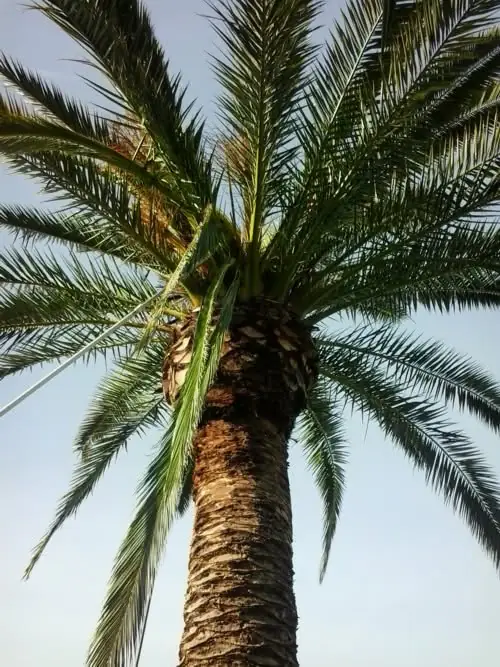
Picture the crown of the palm as a clock face seen from the side. The top fronds point to 12, the bottom ones to 6. The rule says: only remove fronds below the horizontal line running from 9 to 3. Everything above that line stays.
Why? Because the fronds above the horizontal are the youngest and most productive. The fronds below it are ageing, drying or already dead, and the palm has already drawn most of the nutrients out of them. Cutting those does no harm. Cutting the upper ones does.
On well-kept palms a 9-to-3 cut leaves a round, full crown. On Phoenix canariensis the cut is often taken slightly tighter, leaving a half-sphere, and that is the classic look of the Algarve avenues.
What comes off in a palm clean
- Dead or brown fronds, cut close to the trunk without wounding it
- Green fronds below the horizontal that are broken, diseased or touching roofs and cables
- Flower and fruit stalks (dates), which are heavy, drop, attract rats and wasps and cost the palm energy
- Old leaf bases on the trunk, on species where a smooth or pineapple finish is done
- Rubbish, abandoned nests and plants growing in the axils (fig seedlings and climbers are common)
How each species is pruned
Canary Island date palm (Phoenix canariensis)
The commonest and the most demanding. It has huge spines at the base of every frond that go through gloves and boots, and fronds four or five metres long that weigh a lot. We cut the dead fronds and the stalks and do the pineapple cut: the bases of the cut fronds are trimmed into diamonds, forming the typical pineapple pattern just below the crown. Apart from looking good, this cut makes weevil signs easier to see and leaves fewer hiding places for the female to lay. Nothing above the horizontal is cut.
Washingtonia (robusta and filifera)
Tall, thin and fast. The dead fronds do not fall; they hang on and form a skirt that can be several metres long. The whole skirt is removed and the dead fronds cut close to the trunk. On old Washingtonias with years of skirt the job is heavy and the waste enormous. Annual cleaning pays.
Date palm (Phoenix dactylifera)
Similar to the Canary palm, thinner, often multi-stemmed. Same technique. It produces offshoots at the base which, if left, form a clump. Remove them or leave one or two, depending on the effect you want.
Chamaerops humilis, Trachycarpus and others
Smaller garden palms. Dead fronds and stalks are removed. On Chamaerops, watch the fine spines on the stem and the galleries of the palm moth Paysandisia, which mainly attacks these species.
Tools and technique
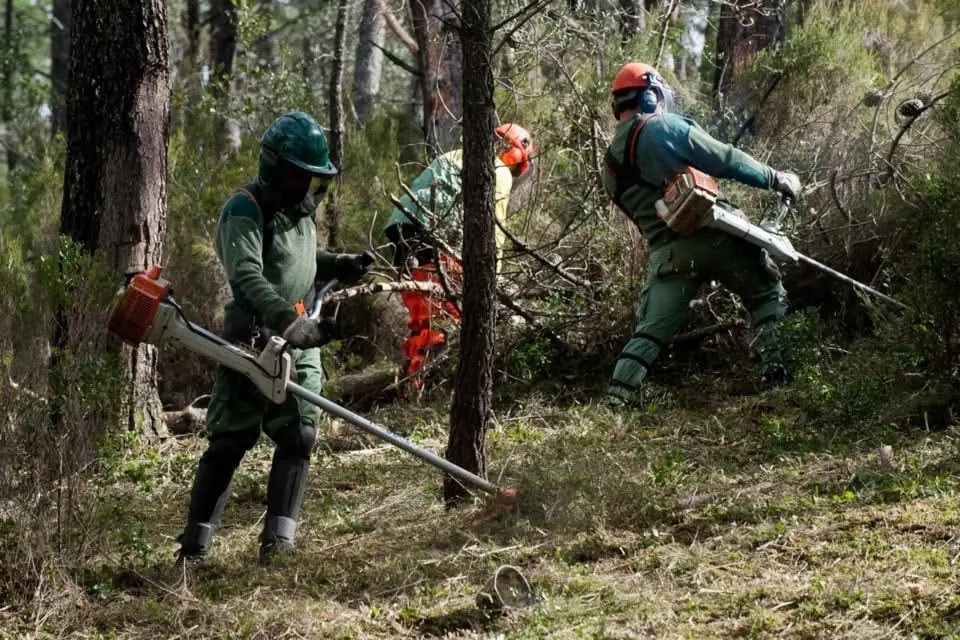
We use hand pruning saws or small pruning chainsaws, always sharp and disinfected between palms. Fronds are cut a few centimetres from the trunk so as not to wound living tissue, with the base trimmed afterwards. Never an axe, and fronds are never torn off.
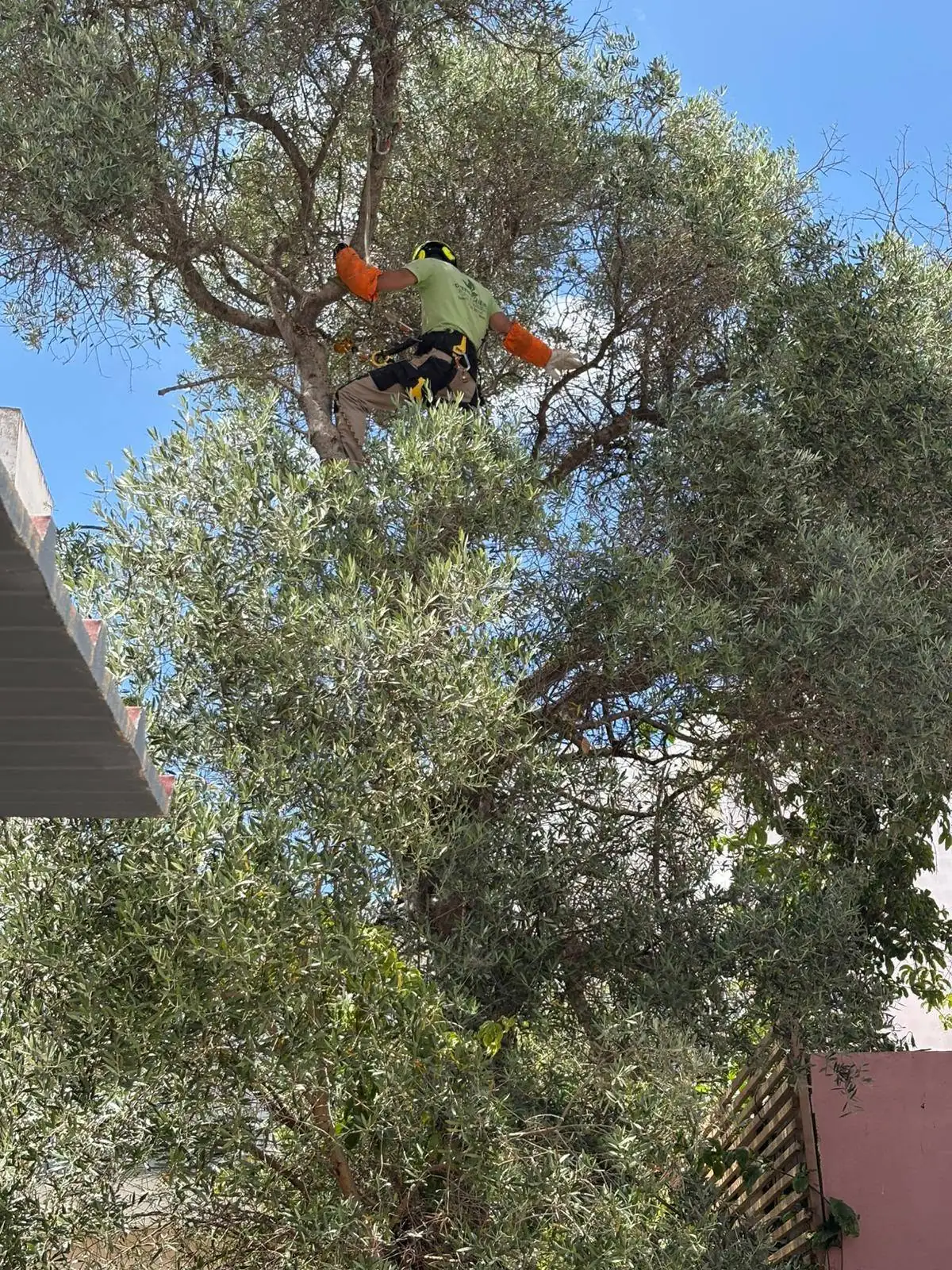
On palms up to three or four metres you can work from the ground with pole tools or from a well-footed ladder. Above that it is work at height: rope climbing with spikes (used carefully on palms so as not to mark the trunk) or a lifting platform. A Phoenix frond falling eight metres onto a person is a serious accident. This is where we strongly recommend calling someone who does it every day.
After pruning
- Apply a protective product or insecticide to the cuts, especially outside the ideal season.
- Remove the fronds and stalks from the plot the same day. Decomposing palm material attracts the weevil.
- Chip them or take them to the recycling centre. In many Algarve municipalities the council collects green waste on request.
- Watch the crown over the following months. If new fronds come out bent or cut, it is a sign of pests.
What never to do
- Cut the top off the palm. It kills it. Only done on palms already dead, for removal.
- Strip the palm or cut green fronds above the horizontal.
- Prune in summer without sealing the cuts.
- Climb the palm with nails or wire. Trunk wounds never heal.
- Paint the trunk or strip the leaf bases on species where that is not done, such as Washingtonias, which end up with a wounded trunk.
- Leave cut fronds piled on the plot.
Palms on condominiums and holiday lets
A good share of the palms we clean in Lagoa, Carvoeiro, Portimão and Albufeira belong to condominiums or holiday rental homes. Those jobs have two extra requirements: the timing has to fit the occupancy (nobody wants a lifting platform beside the pool in August) and the planning has to be annual, so the management knows the cost and the date in advance. We run annual contracts that include the clean in January or February, preventive weevil treatment from March to November and a quick inspection in midsummer. For owners who live abroad we send photos before and after every visit.
When a condominium has dead or sick palms among healthy ones, we deal with the felling and destruction of the infested material first, and only then clean the rest, so we are not carrying the weevil from palm to palm on tools and cut fronds.
Do I need a permit to prune palms?
No. Pruning palms on private land needs no licence. On condominiums the decision belongs to the management or the owners' meeting. Listed palms and those in public spaces are the council's responsibility. What the law does require is control of the red palm weevil and the removal of dead palms, covered in the weevil guide.
How much does palm tree pruning cost?
It depends on height, species, time since the last clean, access and the number of palms. A garden Phoenix cleaned every year is a short job. A fifteen-metre Washingtonia with ten years of skirt is half a day with a platform and a van full of fronds. On condominiums and estates with many palms the price per palm drops a lot. Send photos on WhatsApp and we give you a figure the same day.
Need help with this?
We do this work every week across the Algarve. Free quote the same day.