In short
Anyone with land in a rural area must clear a 50-metre strip around buildings and 100 metres around villages, industrial estates and campsites, with rules on tree spacing, scrub height and branches near roofs. The legal deadline is 30 April each year, sometimes extended. Fines for individuals start at 280 euros and reach 10,000. The cost of clearing depends on area, slope and how dense the scrub is.
Why land clearing is compulsory
The Algarve burns. Monchique in 2018, Castro Marim in 2021, Odemira in 2023. After the 2017 fires at Pedrógão, the land clearing law started being enforced in earnest, with GNR inspections, council notices and real fines. The idea is simple: create a zone around houses where a fire loses strength, so the firefighters can defend them.
The current law is Decree-Law 82/2021, which created the Integrated Rural Fire Management System and replaced the old Decree-Law 124/2006. The principle is unchanged: whoever owns buildings or land in a rural area is responsible for managing the fuel around them. And fuel, in this language, means scrub, dry grass, low branches, built-up leaf litter and trees growing too close together.
Am I obliged to clear my land?
If your plot is in a rural area or on the edge between urban and rural, very probably yes. The obligation falls on:
- Owners, tenants and usufructuaries of buildings in rural areas: a 50-metre strip around the house, barn, stable or covered pool, measured from the outside wall
- Land around villages and settlements, industrial estates, logistics parks, landfills, campsites and infrastructure: 100 metres
- Owners of land crossed by roads, railways and power lines, in the strips defined for each case
A detail that confuses many people: the 50-metre strip is measured from your house, but it does not stop at your fence. If the neighbour's plot lies within those 50 metres, the duty to clear it is the neighbour's. If they do not, you can (and should) report it to the council or the GNR.
What is the deadline for clearing land?
The legal deadline is 30 April each year. In several recent years the government extended it to 31 May because of spring rain or a shortage of contractors. Always check the current year's date on your council's website, but do not count on an extension: book the clearing for March or early April.
After the deadline, councils can carry out the clearing themselves and charge the owner, on top of the fine. During the critical fire period, normally 1 July to 30 September but adjusted every year by the government, burning is banned and machines that throw sparks are restricted in scrubland, which in practice means strimming dry ground is limited to certain hours and conditions. One more reason not to leave it until summer.
What the law requires inside the strip
Clearing is not just cutting the scrub. The annex to the law sets criteria for vegetation inside the fuel-management strips. The most important for a plot around a house:
- Scrub and grass: cut, no more than 50 centimetres high. Lower on slopes.
- Distance between tree crowns: at least 4 metres. For pines, eucalyptus and acacias, highly flammable species, at least 10 metres.
- Distance from crowns to the house: at least 5 metres, and no branch overhanging the roof.
- Low branches: trees limbed up to 4 metres, or to half the tree's height on smaller ones.
- No fuel build-up: no piles of firewood, prunings or waste against the walls, and no vertical continuity between scrub, shrubs and crowns.
- In the first 10 metres around the house the rules are stricter and the most flammable species should not be present.
This does not mean scraping the plot bare. Olives, carobs, cork oaks and fruit trees that are well spaced and limbed up can stay. Hedges and irrigated gardens around the house are allowed. What the law wants to prevent is the continuous carpet of dry scrub and crowns touching each other and the house.
Fines and inspections
Inspections are carried out by the GNR, mainly its environmental unit SEPNA, by the councils and by nature wardens. The typical process: a notice to clear within a deadline, then an infringement report if nothing is done. Fines for individuals run from 280 to 10,000 euros, and for companies from 1,600 to 120,000 euros. If a fire starts on uncleared land, civil liability follows, and in serious cases criminal liability.
If the neighbour's land is uncleared and a risk to your house, you can report it to the council, the parish council (junta de freguesia) or the GNR. It can be anonymous. In practice, a message with photos and the location of the plot is enough for the council to notify the owner.
How land clearing is done properly
There is clearing and there is clearing. Running a brush cutter through the scrub and leaving everything cut on the ground meets the letter of the law for a few weeks, but by June the plot is full of dry straw again and the cut branches have become fuel. Our way of working:
- Assessment: we measure the required strip, identify trees to keep, limb up or fell, and check access for machinery.
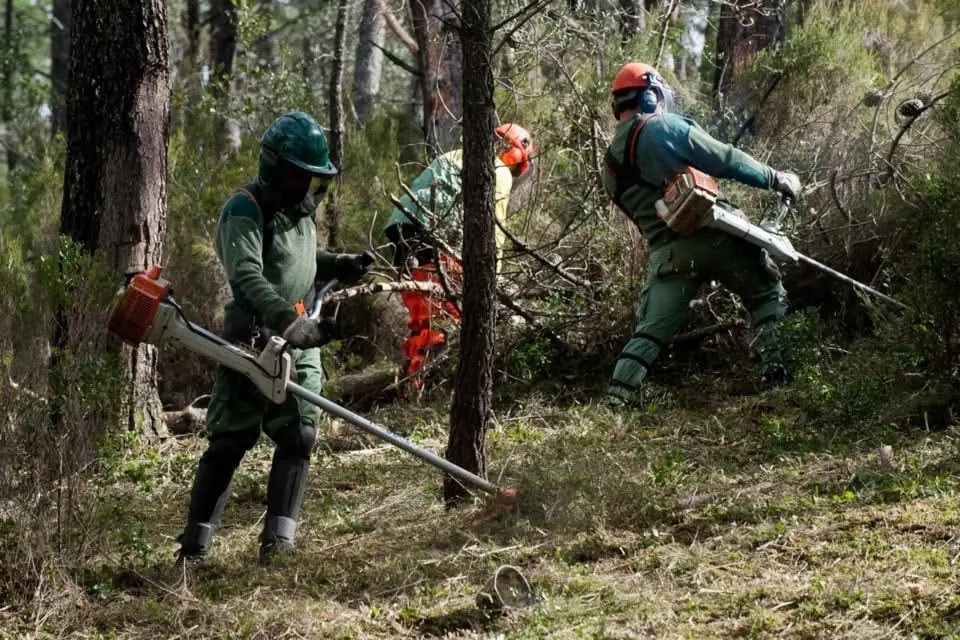
- Cutting the scrub: with brush cutters on small, steep or heavily treed plots; with a tractor and flail mower on large flat ones. We cut low but without turning the soil, to avoid erosion and a flush of weeds.
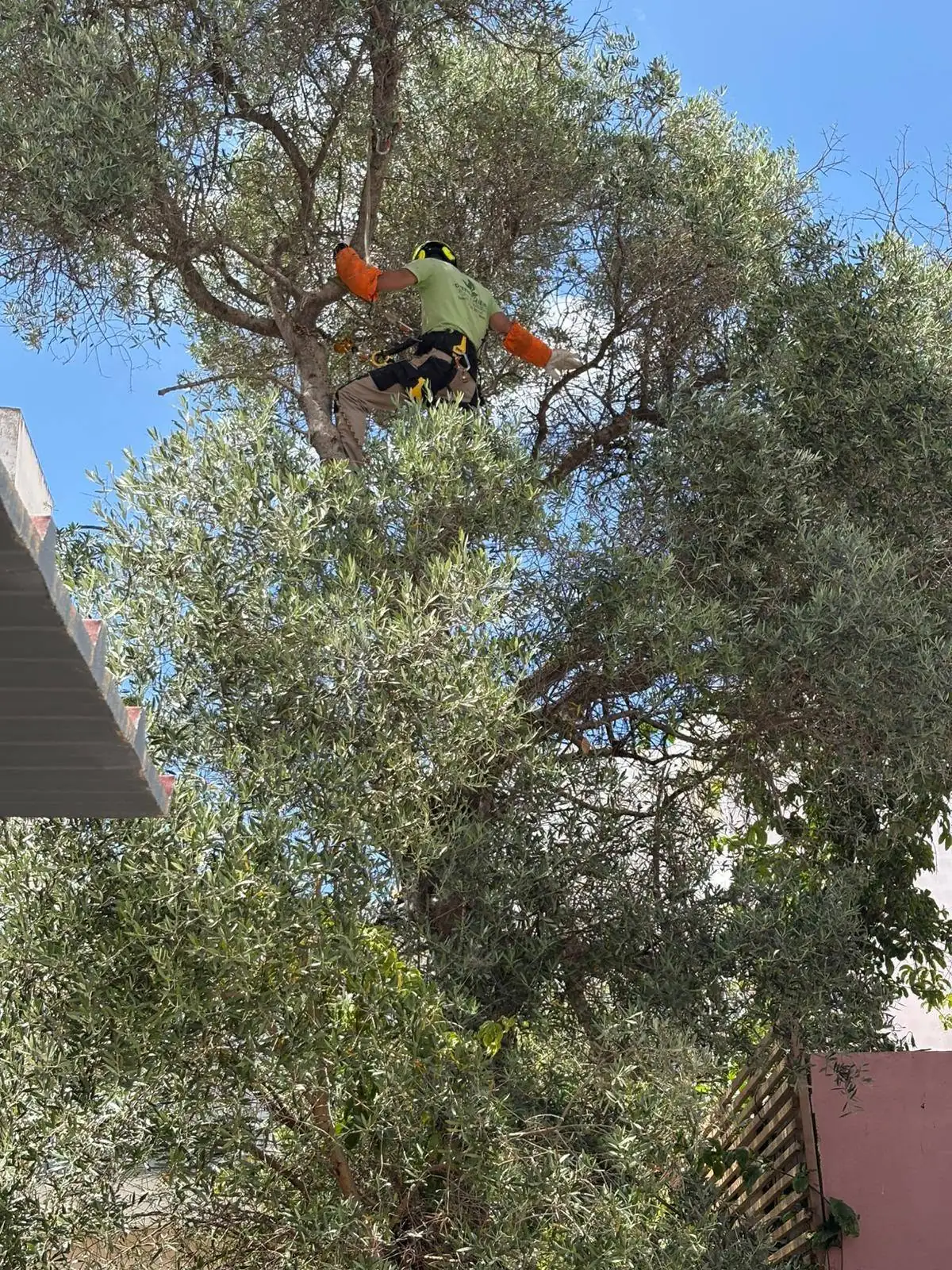
- Limbing and spacing the trees: we remove low branches up to 4 metres, open space between crowns and, where needed, fell pines or eucalyptus too close to the house.
- Removal or chipping: cut scrub and branches are chipped and spread in a thin layer (which dries fast and does not burn hot) or taken away. We never leave piles.
- Sensitive areas: around cork oaks, holm oaks and watercourses we work by hand to respect the protection rules.
On plots neglected for years, the first clearing is the heavy one. After that, one pass a year in March or April is enough and costs far less.
What land clearing costs
The price of land clearing is usually worked out per square metre or per hectare, and varies with:
- Area: large plots have a lower price per m²
- Density and height of the scrub: tall brambles, cistus and gorse take far longer than grass
- Slope and rocks: where the tractor cannot go, it is all by brush cutter
- Trees: how many need limbing or felling, and which species
- Access: whether the machine can reach the plot or it has to be done by hand
- Waste: chipping and leaving on site is cheaper than loading and hauling away
To give an idea, the annual clearing of a villa plot with low scrub costs a fraction of the first clearing of a neglected plot the same size. And both cost far less than the fine, never mind the risk. The quote is free: send us the location of the plot (a Google Maps pin will do) and a few photos, and we give you the price the same day.
Land clearing in Silves, Lagoa, Portimão and Albufeira
Each municipality has its own character. In Silves, especially around Messines, Algoz and the foothills of the serra, plots are big, with cistus, gorse and pine, and the 50-metre strip around isolated houses is almost always the priority. Many plots belong to absent heirs, and we are often called by a neighbour who wants the problem solved once and the cost shared.
In Lagoa and Portimão the rural land sits closer to the housing estates, and the 100-metre strip around settlements catches many unbuilt lots in Porches, Estômbar and Mexilhoeira Grande. They are small plots full of cane and brambles where the tractor cannot go and the work is by brush cutter. In Albufeira, Paderne and Ferreiras, the mix of abandoned quintas and new villas makes the inspections among the most active in the Algarve. In all these municipalities the council publishes an annual list of priority zones; worth checking.
Clearing with a mini digger
Besides scrub clearing, we clear plots for building or for bringing land back into cultivation using a mini digger with operator: removing stumps and roots, levelling, opening tracks and trenches, taking out rubble and rocks. It is a different service from fuel management, priced by the hour or by the job.
Subsidies and common questions
Every year there is news about support for land clearing. In practice, the support exists mainly for owners in financial difficulty and for parish councils, and it varies from one municipality to another. Ask at your junta de freguesia; some Algarve councils have their own programmes and teams that clear at token prices for the elderly and low-income families.
Another common question is whether you can clear by burning. Burning of cuttings only with authorisation from the council or parish, outside the critical period, in suitable wind conditions and never on high-risk days. We prefer chipping: safer, no licence needed and it returns organic matter to the soil.
Need help with this?
We do this work every week across the Algarve. Free quote the same day.