In short
The red palm weevil (Rhynchophorus ferrugineus) kills palms from the inside, and the symptoms only show once the pest is well established. A palm on a preventive plan, with regular applications from March to November, is rarely attacked. A palm whose crown has collapsed usually cannot be saved and must by law be felled and destroyed.
What the red palm weevil is
The red palm weevil, Rhynchophorus ferrugineus, is a reddish-brown beetle two to five centimetres long with a long snout. It came from south-east Asia, spread through the Middle East and the Mediterranean with the trade in mature palms, and was first found in Portugal in 2007, right here in the Algarve. Since then it has killed thousands of palms between Lagos and Vila Real de Santo António, many of them fifty or a hundred years old.
You will see it called palm weevil, palm beetle or, in Portuguese, escaravelho vermelho and bicho das palmeiras. Same insect.
What makes it so destructive is not the adult but the larva. The female lays two to three hundred eggs in wounds on the palm: fresh pruning cuts, leaf axils, cracks in the trunk. The larvae, fat and white and up to five centimetres long, tunnel through the soft tissue of the crown and the top of the trunk for two to three months. Then they spin a fibre cocoon, turn into adults and lay again, often in the same palm. A single Canary Island date palm can hold hundreds of larvae at once.
The adult flies well, several kilometres if it needs to, and is drawn to the smell of cut or fermenting plant tissue. That is why a palm pruned in summer without protection is a target, and why a dead palm left standing in a garden infects the neighbours' palms.
Which palms it attacks
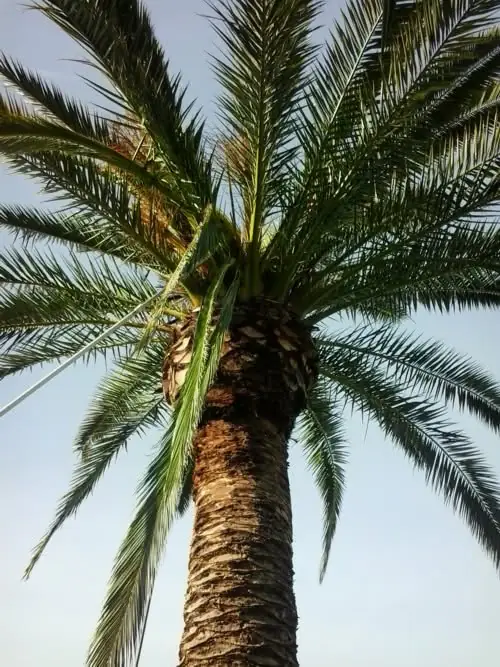
The Canary Island date palm, Phoenix canariensis, is by far its favourite. That is the big, broad palm you see along the avenues of Portimão and Albufeira, on the quintas around Silves and in half the villa gardens of Carvoeiro. The true date palm, Phoenix dactylifera, comes second. Washingtonia, taller and thinner, is attacked less often but is not safe, and we are seeing more cases every year. Chamaerops humilis, the native dwarf fan palm, and Trachycarpus are rarely attacked by the weevil but have their own enemy, the palm moth Paysandisia archon, covered further down.
Signs your palm is infested
The trouble with the weevil is that it works out of sight. For the first months the palm looks healthy while the larvae eat the inside of the crown. By the time you see symptoms, the pest has been there a while. Even so, there are signs worth watching for, and the earlier you catch them, the better the chance of saving the palm.
- Central fronds (the youngest, in the middle of the crown) bent, collapsed or looking as if cut with scissors
- A lopsided crown, one side lower than the other, or an untidy, windswept look
- Finger-sized holes at the base of the fronds or in the trunk, often with damp sawdust and a brown liquid oozing out
- Brown fibre cocoons, like small cigars, lying at the foot of the palm or stuck in the leaf axils
- A fermented smell, like rotting fruit, near the crown
- Fronds that pull out by hand, or a hollow sound when you tap the trunk
- Adults in view, especially at dusk, or larvae when a frond is cut
In the final stage the whole crown tilts, every frond dries out and eventually the head of the palm falls. A Phoenix canariensis crown weighs several hundred kilos. A palm in that state next to a house, a path or a pool is a real danger.
If you spot one or two of these signs, take close-up photos and send them to us on WhatsApp. From the pictures we can almost always tell whether it is weevil, palm moth, drought stress or simply a bad pruning job.
How can I get rid of red palm weevils?
There are three approaches, and they are often combined. Which to use depends on the species, the height, whether there are symptoms and how many palms are on the site.
1. Crown spraying
The most common preventive method. An approved insecticide is applied over the whole crown, paying particular attention to the leaf axils and the centre, where the weevil lays. The application is repeated every thirty to forty-five days during the flight season, which in the Algarve runs from March to November and in warm years never really stops. Outside that season one or two maintenance applications are enough.
Spraying is effective and relatively cheap, but it needs access to the crown (a platform or rope access on tall palms) and care with wind and surroundings: pools, vegetable beds, pets.
2. Trunk injection (endotherapy)
With endotherapy the product is injected straight into the trunk through small holes, and the sap carries it up into the crown. No drift, no smell, and the palm is protected from the inside for several months. Two or three applications a year are usually enough. It is the method we prefer in gardens with children and pets, beside pools and on very tall palms where spraying well is hard.
The drawbacks are the price per application, higher than spraying, and the holes, which have to be placed with care so they do not weaken the trunk.
3. Nematodes and other biological methods
Entomopathogenic nematodes, mainly Steinernema carpocapsae, are microscopic worms that hunt the weevil larvae and kill them from the inside. They are applied in water to the crown, two or three times in spring and again in autumn, and need moisture to work. They are a sound biological option, compatible with organic growing and vegetable beds nearby, but they demand discipline with the schedule. The fungus Beauveria bassiana is another biological option with promising results.
4. Pheromone traps
Traps baited with aggregation pheromone attract adults and are mainly useful for finding out whether weevils are around and how many. On their own they do not protect a palm, and placed too close they can even pull adults into the garden. They go some distance from the palms you want to protect and work as a complement, never as the only treatment.
Curative treatment: can the palm still be saved?
It depends on how far the larvae have got. In an early infestation, where only the young fronds are affected and the growing point at the centre of the crown is alive, the odds are good. Curative treatment means opening up the attacked area, removing the destroyed fronds and tissue, taking out any larvae and cocoons, and applying a systemic insecticide and, where possible, trunk injection. We call it palm surgery. The crown stays smaller for a year or two, then recovers.
If the crown has already dropped, the trunk is hollow or the growing point has been eaten, no treatment will bring it back. Then the job is to fell and destroy the palm quickly, to protect the ones around it.
We are always straight about this. We have seen owners spend money treating a palm that was already lost, and others give up on a palm that could still be saved. A visit, often with a climb into the crown, settles it.
When to treat and how often
A palm that has never been treated and shows no symptoms can start the plan at any time of year. A palm with symptoms is treated now, whatever the month.
Pruning and the weevil
Most of the infestations we see start with a pruning job. Cutting a green frond leaves a large, moist, scented wound, and that is exactly where the female lays. So palm cleaning should be done between November and February, when the weevil is least active, should remove only dead or dying fronds, and the cuts should be sealed with a protective product or insecticide straight afterwards.
The commonest mistake is the exaggerated pineapple cut or, worse, stripping the palm to a tuft of upright fronds. Apart from looking terrible, it weakens the palm and exposes the centre of the crown. We go through all this in the guide on when and how to prune palm trees.
Is the red palm weevil dangerous to people or pets?
No. It does not bite, sting, carry disease or poison anything. You can pick one up. The danger is what it leaves behind: a hollow trunk and a crown weighing hundreds of kilos that drops without warning. That is why dead palms in public places and beside houses are treated as a safety issue, not just a gardening one.
What Portuguese law requires
The red palm weevil is a pest under mandatory control in Portugal. In practice that means the owner of a palm has a duty to monitor it, to treat it when necessary and to fell and destroy palms that are dead or beyond saving, so they do not act as a source of infestation for the palms around them. The national authority (DGAV) sets the rules, and several Algarve councils, including Silves, Lagoa, Portimão and Albufeira, notify owners of dead palms and can carry out the felling at the owner's expense if nothing is done.
Destroying an infested palm properly does not mean cutting it down and leaving it in a corner of the plot. The crown and top of the trunk, where the larvae and cocoons live, must be chipped finely, burned where permitted or taken to an authorised facility. Leaving the whole trunk on the ground for months is the surest way to send the adults inside it flying to the neighbour's palm.
Can I treat it myself?
Up to a point. The products that really work against the weevil are professional-use only, sold to holders of a plant protection applicator card. The products on sale in garden centres are low concentration, never reach the inside of the crown where the larvae are, and give a false sense of security. Behind nearly every lost palm we are called to there are months of home remedies.
What you can and should do: look at the crown of your palms every month, with binoculars if they are tall; never prune in summer; remove and destroy any suspicious fronds or cocoons; and call a professional at the first sign. Nematodes are the one biological option a private owner can buy and apply, as long as the doses and dates are respected.
What palm tree treatment costs
The price of preventive treatment depends on the number of palms, their height, the method and the number of applications a year. A single medium-sized Phoenix sprayed through the year costs a fraction of felling a dead palm and buying and planting a new one. On a condominium or resort with dozens of palms the price per palm drops a lot. Curative treatment costs more because it involves climbing, surgery and several visits.
We do not quote without seeing the palm, at least in a photo. Send us pictures on WhatsApp with the number of palms and the town, and you will have a quote the same day.
Paysandisia archon: the other enemy
Paysandisia archon is a large brown moth with orange and black hindwings, from South America. Its caterpillars bore galleries into the trunk and the base of the fronds, mainly on Chamaerops humilis, Trachycarpus, Phoenix and Washingtonia. The signs differ from the weevil's: young fronds with a fan of aligned holes, as if punched while still folded, sawdust on the trunk and long fibre cocoons. Treatment is similar, with nematodes and systemic insecticides, and the monitoring is the same.
Which palms to plant in the Algarve
If you are planting new palms, think twice before choosing a Phoenix canariensis, however beautiful. Washingtonia robusta and filifera, Chamaerops humilis, Trachycarpus fortunei, Butia and Syagrus are attacked less, though none is immune. Always buy from nurseries with a plant passport and avoid mature palms of unknown origin, which is exactly how the pest got into Europe.
Need help with this?
We do this work every week across the Algarve. Free quote the same day.