In short
In the Algarve, olive trees are pruned between February and March, after the risk of frost and before flowering. Pruning opens the centre into a vase shape, removes water shoots and dead wood, and never takes more than a quarter to a third of the canopy at once. Neglected olives are brought back over two or three years, not in one cut. Removing an olive tree needs a permit in Portugal; pruning does not.
Why pruning an olive is different
The olive is the most patient tree we know. It puts up with drought, heat, poor soil and decades of neglect, and always comes back. But it also reacts to every cut, and a bad prune shows for years: either the tree fills up with water shoots and stops fruiting, or the canopy closes so tightly that olive fly and anthracnose take over.
In the Algarve we see every kind of olive. Productive groves on quintas around Silves and São Bartolomeu de Messines, century-old olives bought as a feature for villa gardens in Lagoa and Loulé, and young trees planted five years ago in Mediterranean gardens in Albufeira and Lagos. Each needs a different prune, and this guide covers all of them.
When to prune olive trees
The general rule is late winter to early spring, once the risk of frost has passed and before the tree flowers. In the Algarve that means mid-February to the end of March. Inland around Silves and up in the hills, where February can still bring frost, we wait a little longer. On the coast, February is fine.
Why this window? The tree is dormant, the sap has not yet risen hard, wounds heal quickly in the warmth that follows and the olive still has time to set flower on the branches that remain. Pruning in November or December, straight after the harvest, is tempting and many people do it, but a hard frost on fresh cuts can kill whole branches.
- February to March: main pruning season in the Algarve
- April onwards: only remove water shoots and suckers, by hand or with small secateurs
- Summer: never prune. The tree is under drought stress and big cuts invite pests and sunscald
- Autumn: possible on ornamental olives that do not fruit, but the following winter can bring surprises
The three kinds of pruning
Formative pruning (young trees)
In the first three to five years the goal is to build the structure: a clean trunk to about a metre and three or four well-spaced main limbs, open like the fingers of an upturned hand. You cut little. Remove suckers from the base and shoots from the trunk, choose the limbs and let the tree grow. A young olive that is over-pruned takes longer to bear.
Maintenance pruning (mature trees)
This is the annual or biennial prune of an olive in full production. The aim is an open, airy canopy with light reaching the inside, because the olive fruits on last year's wood that gets sun. You remove dead wood, crossing branches, anything growing inwards or downwards, and part of the branches that have fruited and now hang. The canopy ends up shaped like a vase or goblet, with an empty centre.
Olives have a habit called alternate bearing: one year they crop heavily, the next they rest. Regular, balanced pruning evens that out. In heavy years you prune a little more; in light years, less.
Renovation pruning (neglected or aged trees)
This is the commonest case on the quintas our clients buy around Silves, Messines or Paderne: olives with ten or twenty years without pruning, a closed canopy, dead branches in the middle, six or seven metres tall and a forest of water shoots. The temptation is to cut it all back at once. That is a mistake. An olive that loses more than half its canopy in one go answers with hundreds of vigorous, fruitless shoots and takes years to settle.
Renovation takes two or three years. In the first, remove dead wood, open the centre and lower one or two limbs. In the second, deal with the other limbs and, among the shoots the tree has thrown, select the ones that will form the new canopy. In the third, fine-tune. At the end you have an olive three or four metres tall, harvestable, airy and productive.
How to prune: step by step
- Look at the whole tree before you cut. Walk right round it. Identify the main limbs and what is dead, broken or crossing.
- Start with dead, diseased and broken wood. This is never too much.
- Remove the water shoots: the vigorous vertical shoots with big leaves that spring from the trunk and the top of the limbs. They do not fruit and they steal sap. Cut them flush at the base.
- Remove suckers around the base of the trunk, at ground level.
- Open the centre. Cut branches growing into the canopy and those that cross. Light and air must get in.
- Lower the height if needed by cutting the limb tips back to a well-placed side branch, never leaving a stub.
- Thin the outside: remove some of the hanging branches that have already fruited, leaving this year's wood, which will flower.
- Stop when you have taken about a quarter of the canopy. If you still think there is a lot left, that is next year's job.
Making the cut
Clean cuts with sharp tools, close to where the branch joins but without damaging the collar (the slightly swollen ring where it emerges). On thick branches, undercut first so the branch does not tear the bark as it falls, then cut from above. On cuts over five centimetres across we apply a sealant, especially on ornamental olives where the scar is on show.
Disinfect tools between trees with alcohol or diluted bleach. Olive knot, a bacterial disease that causes galls on the branches, travels from tree to tree on secateurs and saws. If you see knots and galls on the branches, cut well below the affected part and burn the prunings.
Ornamental olives in gardens
The olive has become the most sought-after garden tree in the Algarve, with good reason: it shrugs off drought, loves sun, grows in any soil and looks right with lavender, rosemary and gravel. In villa gardens the prune has a different goal: shape, not fruit. Keep the canopy rounded or cloud-shaped, remove water shoots twice a year and look after the trunk, which on old olives is the best part.
One thing to know if you bought a transplanted century-old olive: the tree was cut back hard in the nursery to survive the move and will throw a lot of shoots in the first years. That is normal. Keep selecting the best and removing the rest until the canopy is formed. Do not let it close up.
Common mistakes
- Cutting too much at once. The olive answers with water shoots and stops producing.
- Leaving stubs. They dry out, rot and let fungi in.
- Pruning in summer or on frosty days.
- Closing the canopy. No light inside means no olives and pests move in.
- Removing this year's wood, which will flower, and leaving old hanging branches.
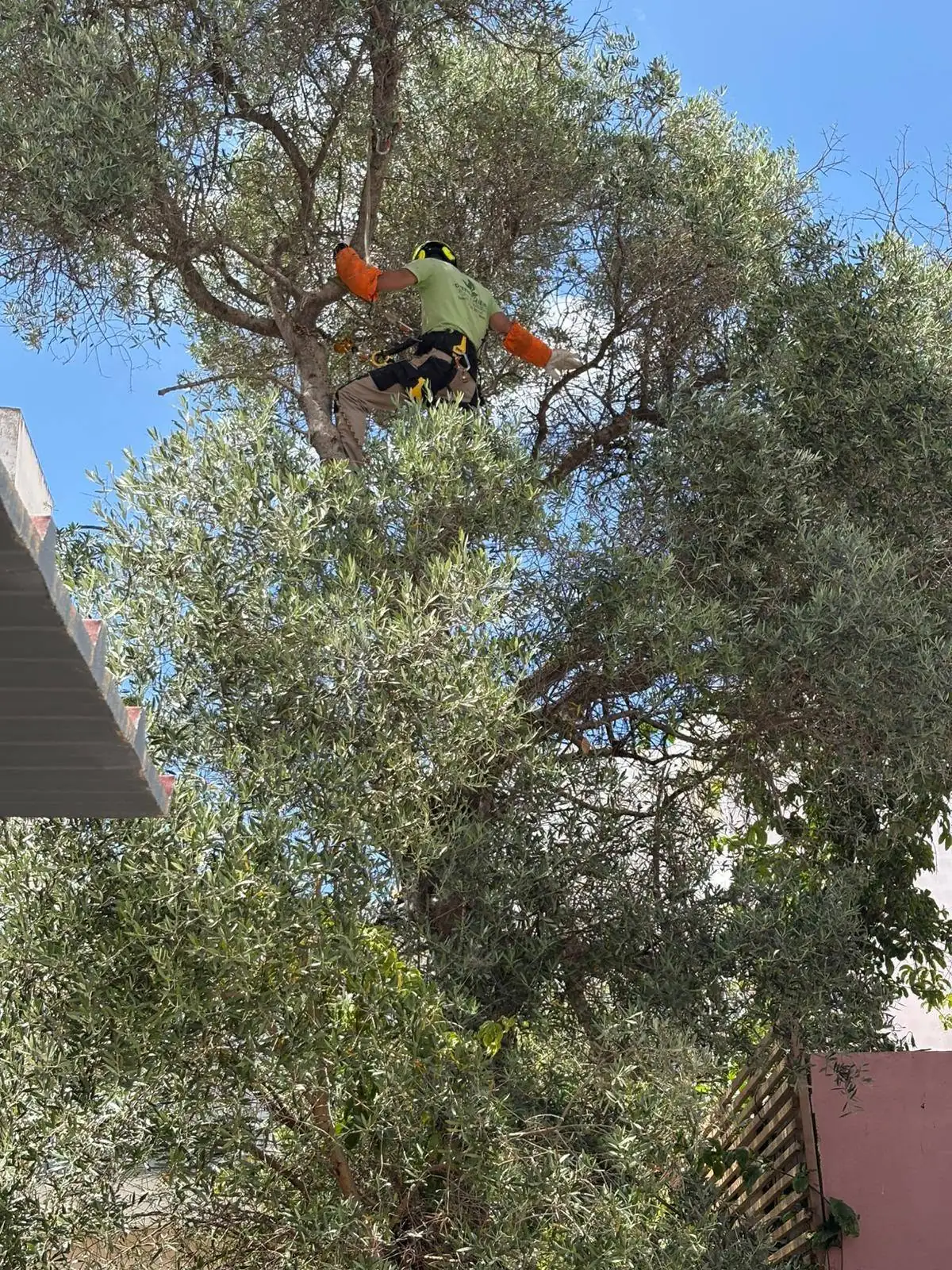
- Working with a chainsaw from a stepladder. A big olive is pruned from a platform or on ropes. Ladder accidents are among the commonest we see.
- Forgetting dirty tools. That is how olive knot spreads.
The law: pruning is fine, removal needs a permit
Pruning olive trees, even severely, needs no licence. Removing or felling them does. Decree-Law 120/86 protects olive groves in Portugal and requires authorisation from the regional agriculture directorate (for us, DRAP Algarve) before uprooting olive trees, even on private land and even for a single tree. There are exceptions for dead or diseased trees and for licensed building works, but it is always wise to apply. When a client asks us to remove olives, we deal with the application first.
The same logic applies, even more strictly, to cork oaks and holm oaks, which fall under the ICNF. We explain that in the guide on permits for cutting trees on private land.
Olives on Algarve quintas: what is different here
Most of the old groves around Silves, Lagoa and Paderne are planted with local varieties, Maçanilha Algarvia, Galega and Cordovil, on limestone barrocal soil or schist in the hills. They were traditionally grown as big, open trees, harvested by hand from ladders, and spaced ten or twelve metres apart. If you have bought a quinta with such a grove, you have inherited a pruning style built for height. Our usual advice is to bring the trees down to a height you can harvest from the ground or a short platform, over three years, and then keep them there. Lower trees also fit the land clearing rules better, with crowns spaced and limbed up, and are far easier to treat for olive fly in summer.
What to do with the prunings
Olive wood is among the best for the fireplace and the barbecue. The thin branches are chipped and make mulch for the grove itself or the garden beds. What you should not do is leave piles of branches on the plot through summer: they are fuel in fire season, and the land clearing law does not allow it near houses. On quinta jobs we chip on site and take away whatever the client does not want.
What olive pruning costs
It depends on the number of trees, their size, their state (an olive pruned every year is half an hour; one neglected for fifteen years is half a day) and what happens to the prunings. In quinta groves we price per tree, falling with quantity. On ornamental garden olives, per job. Either way the visit and the quote are free.
Need help with this?
We do this work every week across the Algarve. Free quote the same day.